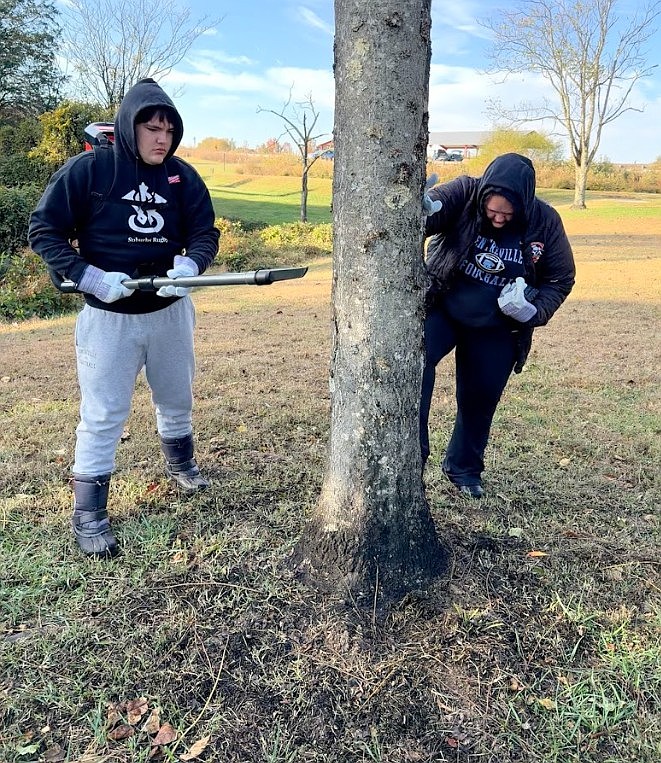
Alexandre Molina and his mom, Dorothy Steel, of Centreville, use both the vacuum and stomp methods for removing Spotted Lantern Fly insects from a Tree of Heaven covered with blackened honeydew
Earlier this year, Northern Virginians were advised to “Stomp, Squish, Slap, Smash!!” when encountering the invasive insect, Spotted Lanternfly in nymph or adult form. (See The Connection, South Edition, Sept 4-17, 2025, pg.6,7). Now that the insects have reached the next stage of their life cycle, it is time to update recommended management of the insect’s egg masses. It’s time to “Spot, Scrape, Squish!”
Managing those early stages caught on, as many people were seen eliminating insects on trees or as they flew near. You may have managed to stomp and squish impressive piles of the insect in nymph or adult form. Or perhaps you tried the more effective method of sucking up the quick moving and jumping insects with a handheld or backpack style vacuum. Unfortunately, no matter how determined the effort, chances are it did not get all the insects. Many were unreachably high on trees, or well hidden with their camouflage color mix of white, brown, black and scarlet.
The past months have been a chance to get to know the enemy. The Spotted Lanternfly is a type of planthopper insect. Both adults and their immature nymphs feed in large groups, by sucking sap from plant stems and tree trunks. Most commonly found on invasive Tree of Heaven, you may have seen them on grapes, peaches, apples, walnuts, oaks, and pines. You may have been drawn to notice them by the sugary waste substance, called honeydew, which accumulates on plants where they fed. At times, the sap fell like rain from upper parts of the tree. The honeydew also supported the growth of a sooty mold, creating a black blanket on tree trunks and plants below; making impacted trees stand out. Often the honeydew attracted bees and wasps to the nectar. While the lantern flies themselves do not bite or sting, other attracted insects created a need for caution. That included the ground bees sometimes choosing to nest near this source of nectar as they created their over-wintering nests.
We have now come to the period, from September through April, when female Lanternflies lay their egg masses. Slowed by eggs in their abdomens, they are not able to move and jump as fast. All adults will die off in the cold. The eggs overwinter, with hordes of nymphs hatching in the Spring. Egg masses are difficult to spot. Initially a white, waxy substance when first laid, they are covered and dry to look like thin, light grayish splotches of mud or cement, typically about an inch long and 3/4 inch wide. They could be anywhere that provides some protection from wind and winter elements. On trees they tend to be on the underside of branches, at protected branch forks, or on leeward sides of trunks. They could be found on rocks, patio furniture, sheds, even car tires.
Each egg mass holds 30 to 50 eggs. Scraping and squishing the egg mass is the easiest way to reduce the future population of Spotted Lanternfly, without using pesticides. For those you can reach, it’s easy. Squish the eggs by dragging a putty knife, or perhaps a credit card, or any hard implement across the egg mass. The eggs will pop as you press down, becoming unviable. A second option is to scrape the egg mass into a bag containing rubbing alcohol, hand sanitizer, or liquid dish detergent soapy water, making sure the eggs come in contact with the solution; then discard the bag.
Some egg masses may be hidden from view, others frustrating high up in trees and unreachable. That means that you may very well see Lanternfly nymphs and adults next Spring — but destroying all the egg masses you can find will significantly help to reduce their population. On your next outdoor excursion, treat yourself to an egg mass treasure hunt. Your prize — an improved and more pleasant natural environment come Spring. Happy hunting.